Enter your administrator credentials to manage content.
Invalid credentials. Please try again.
Contact your system administrator to request access.
Scatti e Arte Galleria presents
Museo della Terra
Rooted in the beauty of Santa Domenica Talao, our community-supported cultural hub is a shared home for local art and history. Every exhibition and workshop we host is dedicated to celebrating our village's heritage and ensuring that creativity continues to thrive at the heart of our historic hilltop.
📷
Photography
Celebrating the art of the lens — local and international.
🏛️
Cultural Heritage
Preserving the history and soul of Calabria.
🎨
Visual Arts
Paintings, installations, and mixed media exhibitions.
🤝
Community
Free admission, open to all. Always.
What's On
Upcoming Events
Exhibitions, workshops, and community gatherings at Museo della Terra. Events are updated regularly by our team.
Loading events...
Tour del Borgo
Walking Tour
A self-guided walk through 12 historic stops in Santa Domenica Talao — from the founding piazza to the Museo della Terra itself.
✦ The Story of Our Village
Santa Domenica Talao
Founded 1620 · Calabria, Italy
Santa Domenica Talao was founded in 1620 by Prince Ettore Spinelli of Scalea, a feudal lord who fell in love with these hills — rich in fountains, springs, and panoramic views of the sea. He invited the inhabitants of his fief to settle here, offering a reduction in their taxes in exchange. Among the first to arrive was Giovanni Andrea La Greca, a shepherd from Mormanno, who worked tirelessly to build the village and is considered, alongside Prince Spinelli, its true founder.
The village grew rapidly around the church and bell tower. From just 30 households in 1669, it grew to nearly 3,000 inhabitants by the mid-1800s. The fertile valley below was cultivated with vineyards, fig orchards, wheat, and olive groves — produce so abundant it was exported by ship from the port of Scalea to tables near and far.
Between 1870 and 1920, many of Santa Domenica Talao's residents emigrated to the Dominican Republic, settling in Santiago, Puerto Plata, and Moca. They became merchants, doctors, and entrepreneurs — and though far from home, they never forgot the village. In 1917, they founded the "Società Pro Santa Domenica Talao," raising funds to build the clock on the bell tower, restore roads, construct the first vehicle road, install the first aqueduct, and bring public lighting to the hilltop. Their story is one of the most moving chapters in the village's history.
“The valley at the foot of the hill looked like a single vineyard — so many were the rows of vines.” — Parish manuscripts, 1800s
1
Piazza Italia · Terrace
Piazza Italia — The Founding Terrace
Your walk begins at the main terrace of Piazza Italia — the heart of the village founded in 1620 by Prince Ettore Spinelli of Scalea. From here, enjoy the sweeping panorama of the valley and sea that captivated the prince himself. The village grew from 30 households in 1669 to nearly 3,000 inhabitants by the mid-1800s, its fertile valley once described in parish records as looking like "a single vineyard — so many were the rows of vines."
2
Mural
Mural in the Square — The Dominican Republic Emigrants
This mural, created in July 2025, honors the emigrants of Santa Domenica Talao who settled in the Dominican Republic between 1870 and 1920. Arriving in Santiago, Puerto Plata, and Moca as cloth and goods merchants, many grew their enterprises into major import-export companies trading cocoa, tobacco, and food. In 1917, they founded the "Società Pro Santa Domenica Talao" to send money home — funding the clock on the bell tower, road improvements, the first vehicle road, the first aqueduct, and public lighting. The society's most passionate founder, 23-year-old Angiolino Grisolia, died in 1921, and the association was named in his honor.
3
Mural · Water Route
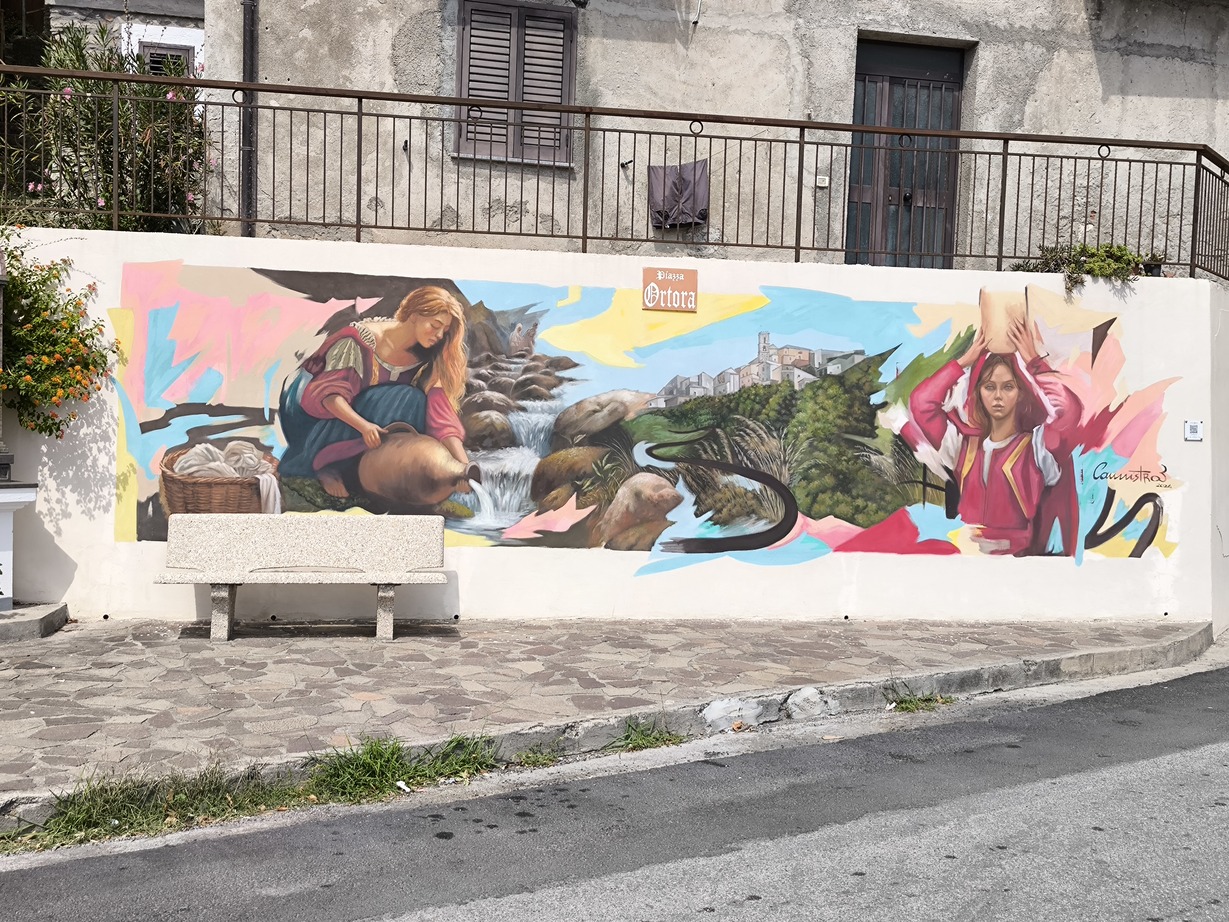
Ortora Mural — “La Via dell'Acqua”
This mural honors the women of Santa Domenica Talao who for centuries walked a rural path from Piazza Ortora down to the Cannidata stream — collecting water and doing laundry. This path, called "U' spìsatùru" (via Spesatoio), was the only route to the eastern countryside and powered a series of stone mills. After the carriage road opened in 1923, the path fell into disuse, disappearing into vegetation by 1960. Reopened in 2022, it now forms the first stretch of "La Via dell'Acqua," an 8 km trekking trail leading to the springs, streams, and fountains that sustained the village for centuries.
4
Historic Palace
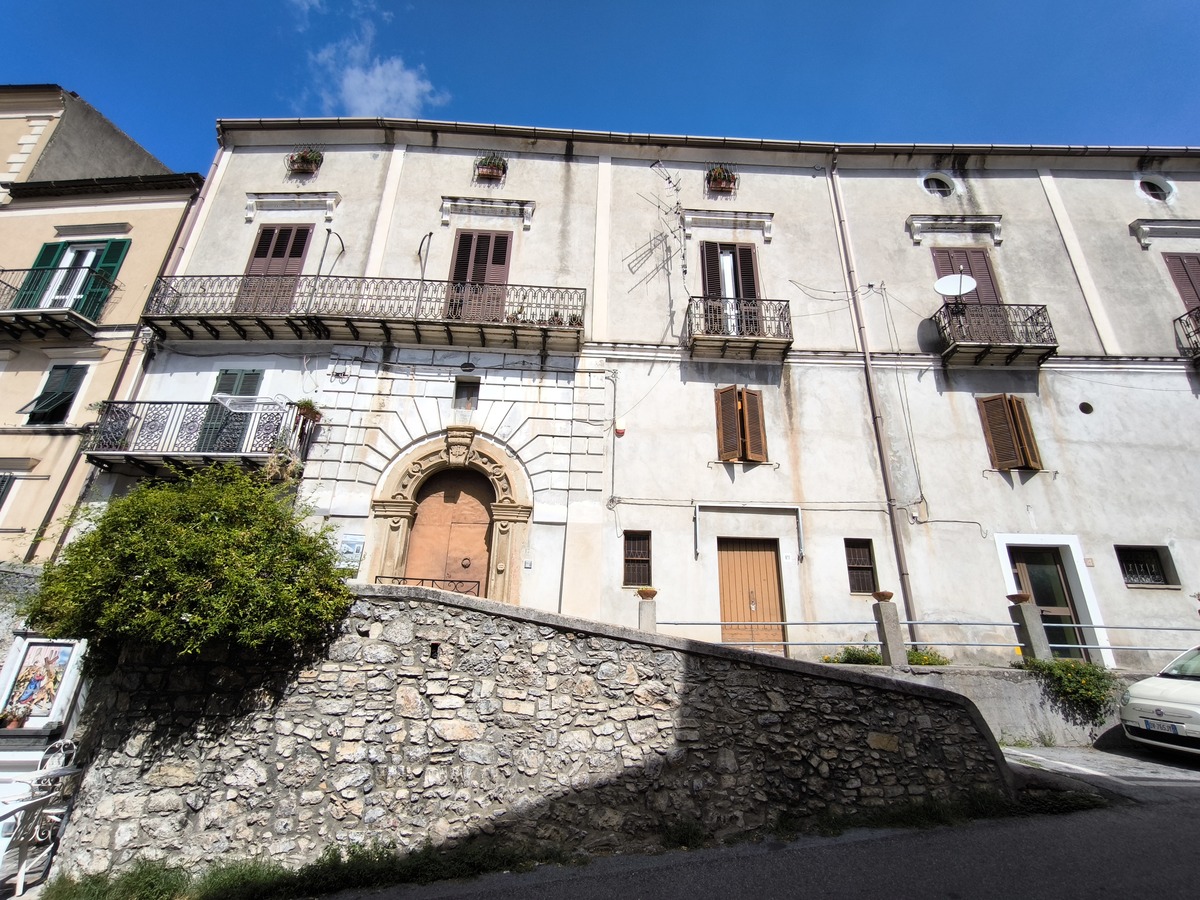
Palazzo Perrone / Senise
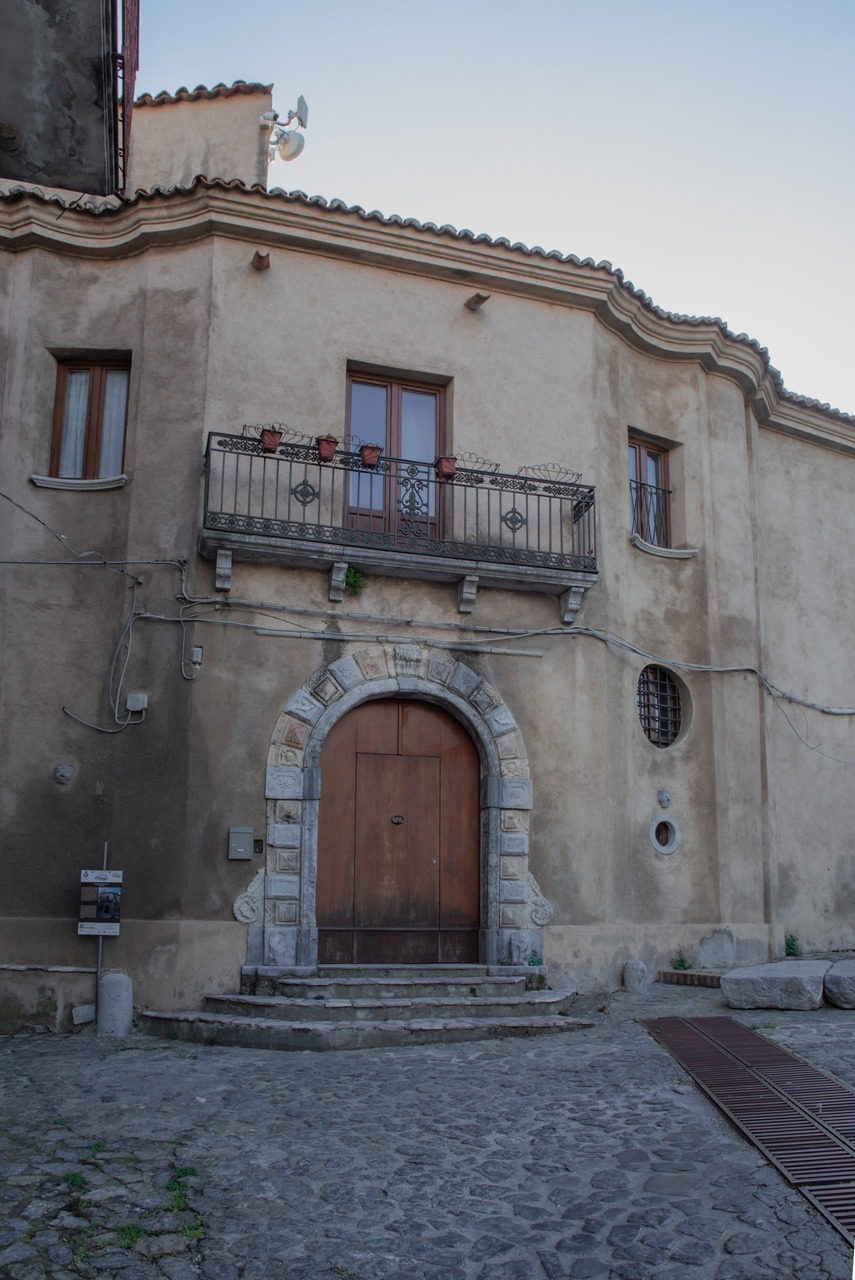
The largest of the historic palaces in the village, built on three levels for an important 18th-century family. On Via XXIV Maggio, a fine tufa stone portal crafted by stonemasons from Fuscaldo marks the entrance. The noble floor above is distinguished by tall balconies with finely decorated railings. From the 1700s into the 1800s, the palace belonged to the Perrone family — landowners who were staunch anti-Napoleonic resisters, earning the village the reputation of a "den of brigands."
5
Church
Chiesa Madre — Mother Church of Saint Joseph
The most important monument in Santa Domenica Talao, built in the second half of the 1600s. Originally a single chapel, expanded in 1701 with a transept, apse, and two bays. Inside: fine stuccos, a polychrome marble high altar (1774), a 19-stall wooden choir, and a Neapolitan school altarpiece with a curious anomaly — the Christ Child is depicted with three buttocks. Pre-1837 burials discovered during restoration are displayed in the crypt.
6
Historic Palace
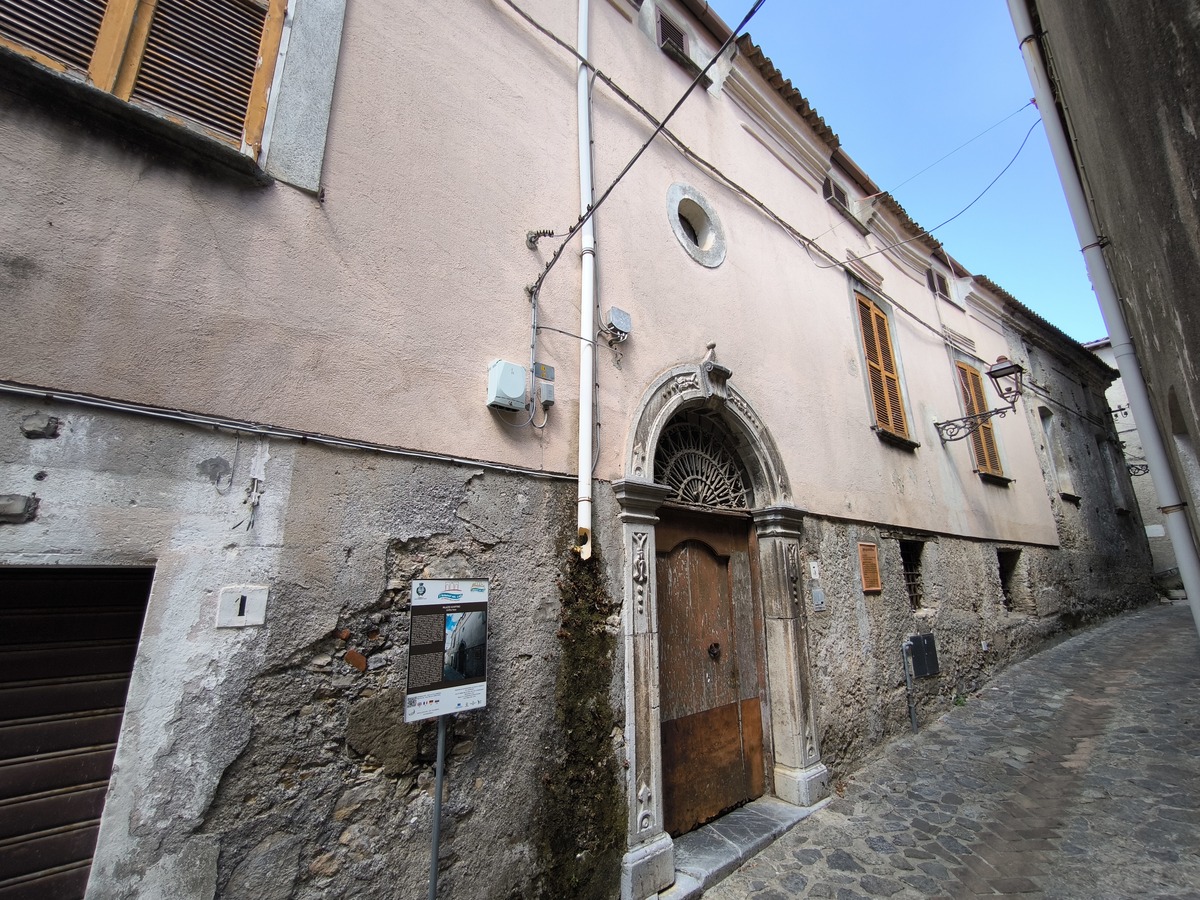
Palazzo Schiffino
A private 18th-century palace just behind the Mother Church, with a bas-relief stone portal on Corso Umberto I. Still owned by the Schiffino family — whose patriarch Don Saverio Schiffino served as a judge in King Ferdinand of Bourbon's Supreme Court of Justice.
7
Historic Palaces
Palazzo La Greca & Palazzo Di Vanna
Palazzo La Greca: home of 19th-century lawyer Don Benigno La Greca, whose descendants include Vicente "Murillo" La Greca — born in Brazil in 1899 and now honored by a museum in Recife. Palazzo Di Vanna next door was renovated in Neoclassical style by a family made wealthy by their Dominican Republic import-export firm.
8
Historic Palace
Palazzo Campagna — Crown Jewel of the Historic Center
The most architecturally distinguished building in the historic center, built in 1774. Its Baroque south façade features four round arches, grotesque masks, and mermaid tiles. Home to Don Leopoldo Campagna, who led anti-Bourbon forces in 1848 — and later occupied for 58 days by Bourbon troops who consumed all the family's reserves.
9
Historic Palace
Palazzo Pezzotti
Home of the Pezzotti family — notable 19th-century doctors and pharmacists who, like many prominent families of Santa Domenica Talao, were also part of the remarkable emigration to the Dominican Republic.
10
Historic Palace
Palazzo Grisolia — Colonial Style, 1928
Renovated in colonial style in 1928 by Dr. Vincenzo Grisolia — surgeon, co-founder of the Dominican University's School of Medicine, and brother of Angiolino (Stop 2). Notable as the first house in the village to have central heating (1928). Sensitively restored by new owners in 2024.
11
Chapel
Cappella di San Giovanni Evangelista
A small 18th-century chapel built by Don Giovanni Longo and his sister Dalmazia, dedicated to Saint John the Evangelist. Lovingly restored and reopened to the public in 2023 after years of closure.
12
Final Stop · Museum
Museo della Terra — Museum of the Earth
Your tour ends at the Museo della Terra — three halls covering rural life (Hall A), local geology and 8-million-year-old fossils (Hall B), and traditional 18th-century costumes (Hall C). The museum also houses the Scatti e Arte pinacoteca, featuring paintings by Luther and Timi Di Salvo, the museum's managers and the heart of this cultural project.
For the Public
Products & Services
Professional printing and creative services open to the public. All proceeds directly support the Museo della Terra's non-profit mission.
Walk-ins welcome during opening hours. Large orders by appointment. All services fund our non-profit mission.
Make a Difference
Support Our Space
Museo della Terra is 100% community-funded. Your support — wherever you are in the world — keeps art and culture alive in Calabria.
💛 Donate & Support
Your donation funds exhibitions, educational programs, community events, and keeps our doors free and open to everyone.
We accept international donations easily and securely. Every contribution, large or small, makes a real difference.
Our space is wheelchair accessible. Large-print materials and audio assistance available on request. Please contact us in advance for specific accessibility needs.
⚙ Admin Dashboard
Museo della Terra · Scatti e Arte Galleria |
Manage Events
Add New Event
✓ Event saved!
Current Events
Loading events...
Homepage Announcement
Post a banner message visible to all visitors on the homepage (e.g. closure, special event, holiday hours).
✓ Saved!
Hours & Contact Information
Opening Hours
Contact Details
✓ Saved! Visible to visitors now.
Manage Services
Add New Service
Add, edit, or hide any service. Changes appear immediately on the public Services page.
✓ Service saved!
Current Services
Use Hide to remove a service from the public page without deleting it permanently.
Loading services...
Donation Button & Text
Update your donation platform at any time — change the link, button label, and description in both languages. Changes go live immediately for all visitors.